Leak Detection and Repair in Washington, IL
Trace the leak first, then open only the wall or ceiling that needs it.
- 4.8 on Google, 16 reviews
- Open 7 days, 7:15 AM to 6:15 PM
- Based in Washington, IL
- Google reviews going back 10 years
Leak detection and repair in Washington, IL begins with proving where the water is going before anyone cuts into a wall. A rising water bill, a stain that keeps growing or a meter that moves with every tap closed all point to a leak you cannot see. Finding it precisely is what keeps the repair small.
What Signs Point to a Hidden Water Leak?
Suspect a leak when water use rises and nobody changed habits.
- A water bill that climbs with no new appliance, guests or lawn watering
- A meter dial that keeps turning with every fixture off
- A yellow or brown ring on a ceiling, or paint that bubbles and peels
- A musty smell in a closet, cabinet or basement corner
- Baseboards that swell, or flooring that cups and lifts
- The sound of running water in the walls at night
- Water pressure that drops without warning
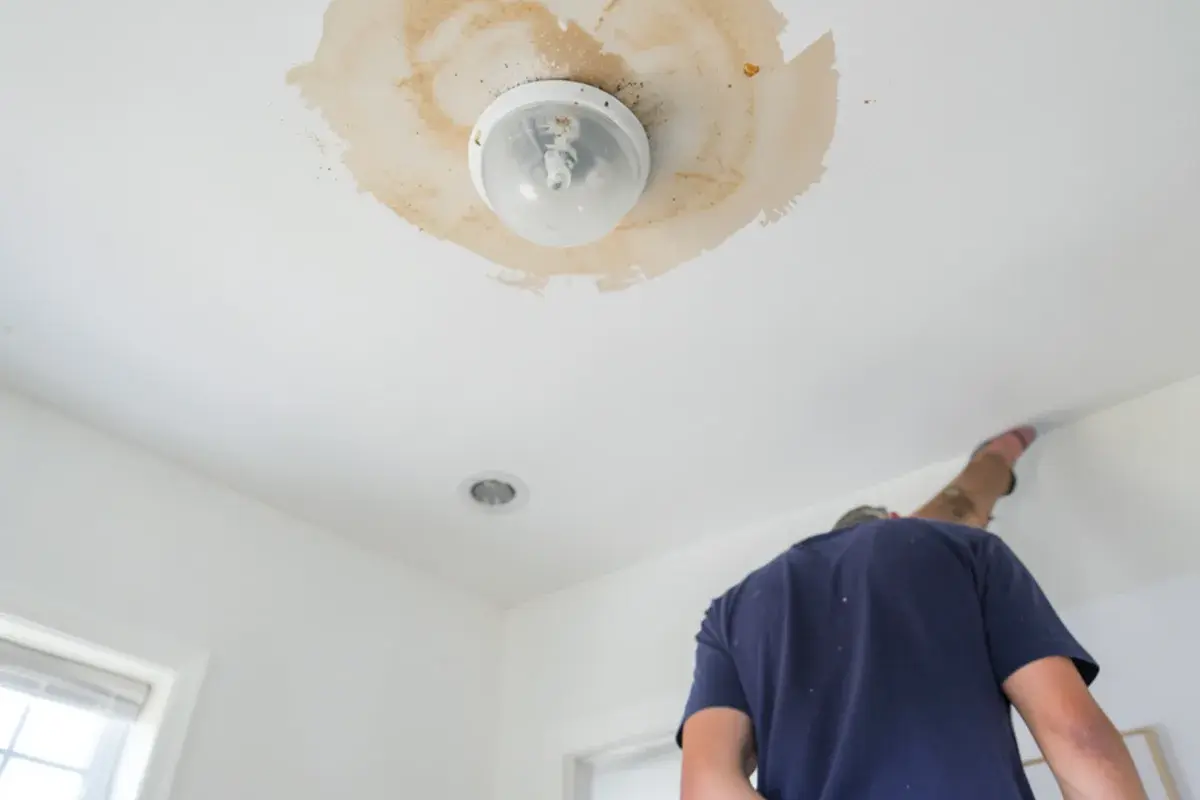
One stain does not tell you the leak is above it. Water follows framing and pipe before it drops, so the wet spot can sit several feet from the source.
Check Your Water Meter Before You Call
The meter test takes two hours and tells you whether a leak exists. Turn off every tap, the dishwasher and the washer. Read the meter, wait two hours without using water, then read it again. The EPA says a changed reading probably means a leak.
Then close the main shutoff valve inside the house and watch the meter. If it still moves, the leak is on the line between the meter and the house. If it stops, the leak is inside the house.
A toilet is the usual silent suspect. The EPA's dye test is to put a few drops of food coloring in the tank, wait 10 minutes and check the bowl. Color in the bowl means the flapper is leaking.
What Does a Small Leak Cost on a Washington Bill?
A small leak costs less than a burst pipe, but it never takes a day off. The EPA puts the average home's leak loss at more than 9,300 gallons a year. At Washington's published rates of $3.28 per 1,000 gallons for water and $6.01 for sewer, that is roughly $86 a year if the sewer charge follows metered use. Check the current rates with the city.
The bigger cost is damage. A hidden supply leak can soak insulation, rot a sill plate and feed mold long before the bill moves.
Water bill climbing with no explanation? Call (209) 563-1400
Open 7 days, 7:15 AM to 6:15 PM. Tell us what is happening and we will give you a clear, upfront quote.
Request a Quote
Water moving right now? Call first: (209) 563-1400. For anything that can wait, send the details here.
Do Slab Leaks Happen in Washington, IL?
They are uncommon here, and that works in your favor. Most homes in this part of Central Illinois sit over a basement or crawl space, so supply lines run through open floor joists. We can often trace a drip from below and confirm the leak without opening a wall.
A garage, a room addition or a slab-on-grade lower level still has pipe under concrete. The clues are a warm spot on the floor, hot water that seems to run constantly, or the sound of flowing water with every fixture off.
About 13% of units date to 1939 or earlier, and the largest build decade is 2000 to 2009, at 21% (Point2homes, citing Census data), so we look before we guess.
How Does Leak Detection and Repair Work in Washington?
The method is elimination, in a fixed order, so the cut in your wall is the last step and not the first.
- Hear the history, then run the meter test. When did it start, where is the stain, and is water leaving the system?
- Isolate the system. We close valves to split the house into sections: hot side, cold side, outdoor lines, the water heater feed.
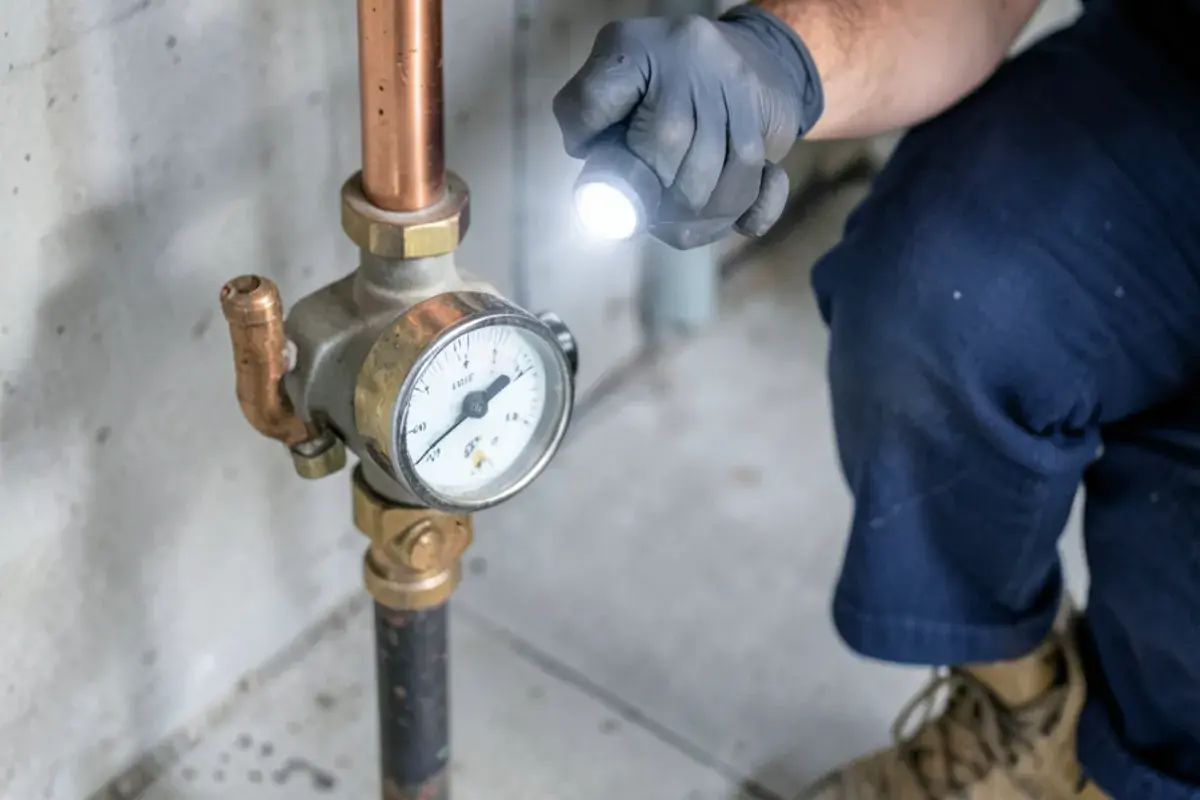
- Pressure test the suspect line. A line that will not hold pressure has the leak.
- Read the moisture. A moisture meter tracks the wet path in drywall, wood and subfloor back toward its source.
- Open the smallest access. A cut sized to the fitting, in the right place, beats a large hole in the wrong one.
- Repair, test and close. We fix the pipe or fitting, restore pressure, then confirm the leak is gone before closing anything.
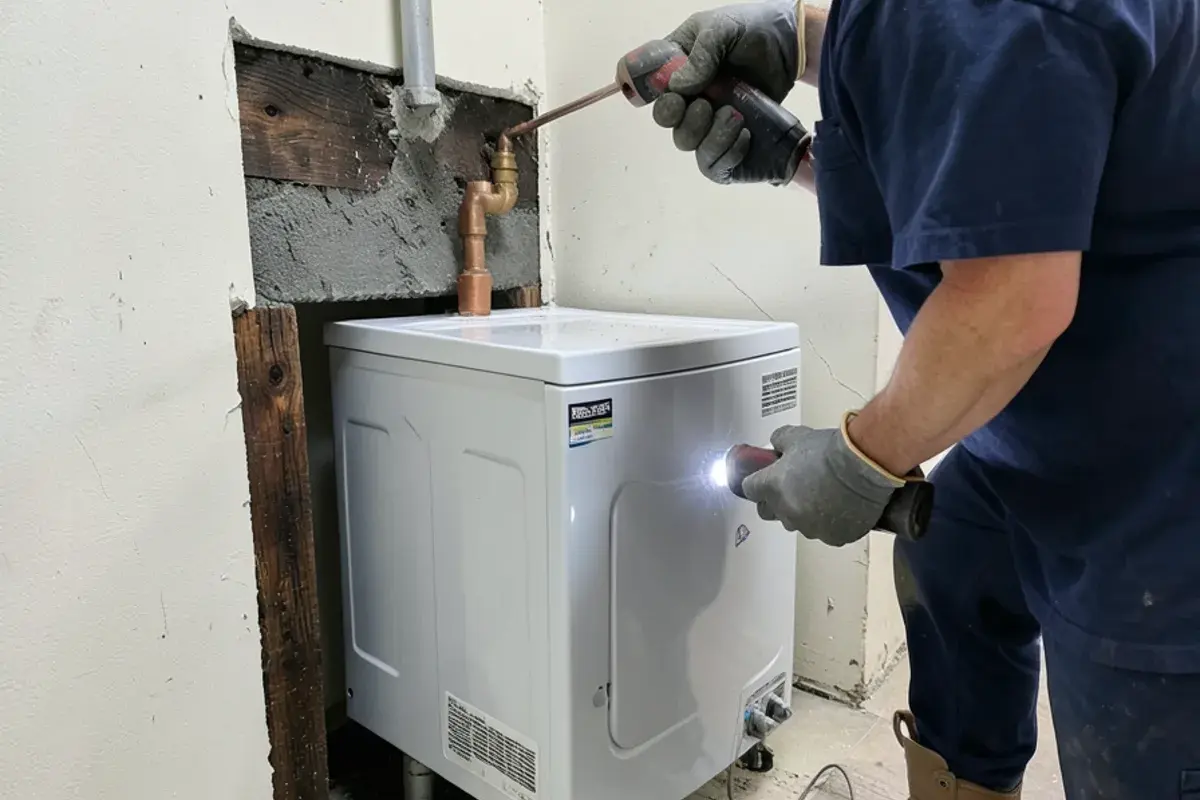
Supply, Drain or Fixture: Which Kind of Leak Is It?
The kind of leak decides the test. A supply line leaks all the time, a drain leaks only when water runs, and a fixture leaks at the fixture.
| Type | What you notice | How it is found |
|---|---|---|
| Supply line | Meter moves with everything off; pressure drops | Meter test, then pressure test by section |
| Drain line | Stain appears only after a shower, sink or washer runs | Run each fixture while watching the wet area |
| Fixture or connection | Damp cabinet, wet floor around a toilet, drip at a washer valve | Visual check and dye test |
A drain leak can be missed by the meter test, because the water that leaks was already used. If the stain appears after a load of laundry, say so on the phone.
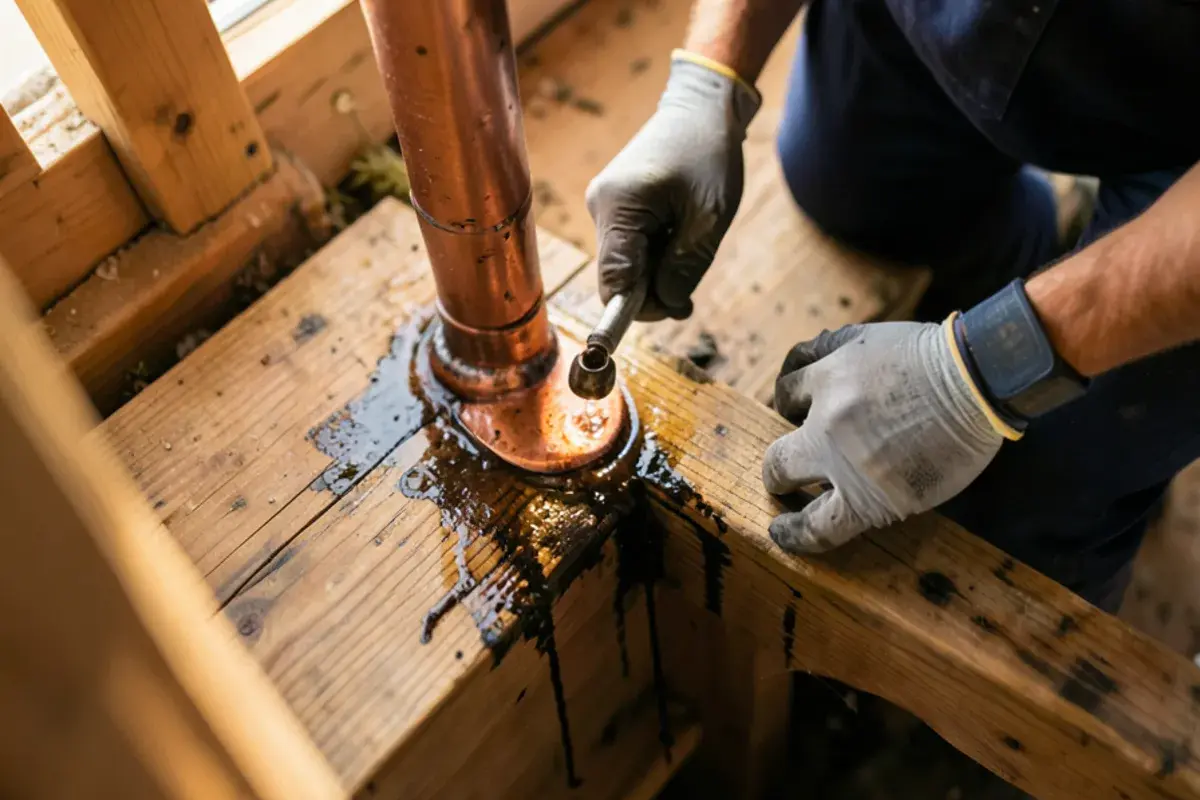
What Happens After We Find It?
Leak detection and repair covers the whole job, from proving the leak to proving the fix:
- Confirming the leak with meter, valve and pressure checks
- Mapping the wet path with moisture readings
- Opening the smallest access where the pipe actually is
- Repairing the pipe, fitting or connection that failed
- Testing the line before anything closes
The repair matches the failure, and you decide with the facts in front of you. A split section is cut out and replaced. A failed fitting is remade. If the pipe is corroded along its whole length, patching one spot only moves the leak, and a section or whole-run replacement may make more sense. Our repiping page covers when that decision comes up.
If water is actively flowing, read our emergency leak repair page first. For a pipe that has split under pressure, see burst pipe repair.
Drywall, paint and flooring are separate trades, so we tell you what was wet and you choose who finishes the surface.
What Moves the Price of Leak Work?
You get a clear, upfront quote before we cut anything. These are the factors:
- Location. A leak visible from a basement ceiling takes less time than one inside a finished wall.
- Access. A pipe behind a tiled shower or under a built-in cabinet needs more careful opening and closing.
- Pipe material and age. Old galvanized pipe is harder to repair than copper or PEX because it can crumble at a cut.
- How many spots. Aging pipe often leaks in more than one place.
- The house. Washington runs from pre-1940 galvanized to 2000s PEX, so one symptom can mean a small job or a large one.
- Which side of the meter. A leak in the yard line can mean digging, not just a wall cut.
- Hourly context. For reference only, thecostin.com's 2026 figures put licensed Illinois plumbers at $75 to $130 per hour. That is a published estimate, not our quote.
Which Illinois Rules Cover a Leak Repair?
The Illinois Department of Public Health requires a license for anyone who repairs or maintains plumbing, under 225 ILCS 320. Ask for the number and check it.
The Illinois Plumbing Code gives a yardstick for the finished work. Section 890.1930 tests a water supply system at 1.5 times system pressure, at least 100 psi, for 15 minutes.
A leak between the meter and the house sits on the water service pipe, which Section 890.1150 puts at least 36 inches down, deeper where frost goes deeper. Repairing it means digging, so JULIE gets a call at 811 at least 48 hours ahead. Ask the city which part of that pipe is yours.
How Do You Catch the Next Leak Early?
- Learn where the main shutoff valve is and turn it once a year so it does not seize.
- Read the water meter on the first of each month. A rising number with the same habits is a warning.
- Look under every sink and behind every toilet twice a year.
- Replace rubber washer hoses that bulge or crack.
Why Professional Sewer & Drain for This Work
A leak behind a laundry room
Vijay K. wrote that he called Monty on a Saturday morning about water leaking behind his laundry room, and that Monty came right over and fixed it.
You hear what we found
Jason P. and Roben V. both wrote that we explained how to stop the next problem. After a leak is found, you should know why that pipe or fitting failed.
Open seven days
Our Google hours run 7:15 AM to 6:15 PM every day, and customers have reviewed Saturday and Sunday calls.
Pricing reviewers called reasonable
Seven of our Google reviewers called the pricing reasonable or affordable. You get a clear, upfront quote before we open anything.
What Customers Say
4.8 out of 5 from 16 Google reviews, checked November 2026. Read all reviews
“Had water leak behind laundry room. Called Monty on a Saturday morning and he came right over. He did a wonderful job to fix the issue. Very professional and knowledgeable. I highly recommend this company.”
“I am so thankful for Monte coming out during the coldest day with blizzard conditions with same day service. He was very kind and worked quickly to rectify issues with plumbing and gave suggestion for future work that needs to occur to prevent any further issues. His services are very reasonable given the work that he did. I will always use him for any issues in the future. Thank you for all that you did for us today and so thankful that you got home safe!”
“Dropped everything late in the day on a Saturday to fix our backed up kitchen sink. Price was super reasonable for day/time/speed of arrival. Highly recommend.”
Leak Detection and Repair Questions
How do I know if I have a hidden water leak?
Do slab leaks happen in Washington, IL?
Will you have to tear out my wall to find the leak?
Can a leak raise my water bill without any visible damage?
Does homeowners insurance pay for leak detection?
How quickly should a hidden leak be fixed?
Leak Detection and Repair in Washington? Call (209) 563-1400
Open 7 days, 7:15 AM to 6:15 PM. Tell us what is happening and we will give you a clear, upfront quote.
Where We Provide This Service
Hidden leaks show up differently by house. Bluff-top homes in Germantown Hills often have walkout lower levels where a damp wall can be a plumbing leak or groundwater. In the older houses of Metamora and Peoria, aged supply pipe is a more common source. Homes in Sunnyland are a short drive from our Washington base. See every town on the service areas page.
- Germantown Hills: Walkout lower levels can hide leaks that pass for groundwater.
- Metamora: Older village houses may still carry aged supply pipe.
- Sunnyland: A short trip along Route 8 from our base.
- Peoria: Pre-1940 homes make up a fifth of the housing.
- Morton: Established streets mean decades-old fittings inside finished walls.
- East Peoria: Low river ground makes a damp wall harder to read.
- Pekin: With 21% of homes before 1940, a stain deserves tracing.
- Eureka: Rental turnover means a slow leak can go unreported.