Comparison and decision guides
Tankless vs Tank Water Heater for Illinois Homes
Published November 1, 2026. Updated November 1, 2026.
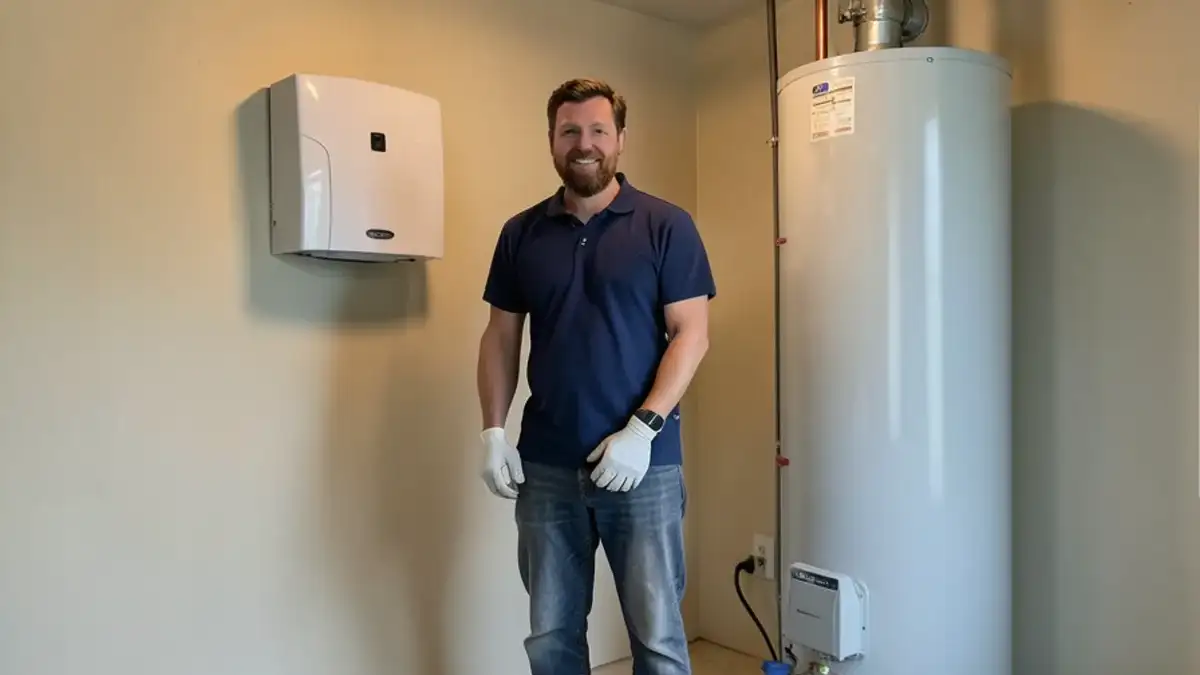
Tankless vs tank water heater comes down to your household, not a winner for everyone. A tank costs less to buy and replace. A tankless unit saves standby heat and lasts longer, but it has a flow limit that Illinois winters make tighter, and it can need new gas piping and venting. Here is how to decide.
Tankless vs Tank: Which Water Heater Wins for Your House?
Neither wins everywhere. This table compares the points that decide it in Central Illinois.
| Point | Tank | Tankless (gas) |
|---|---|---|
| Purchase and install | Lower, simple swap in most cases | Higher, often needs piping and venting work |
| Energy | Loses heat through the tank walls all day | No standby loss, bills can drop 10 to 20% per a DOE-linked document |
| Expected life | About 10 to 15 years | More than 20 years |
| Hot water supply | Finite, runs out in long use | Endless, limited by flow rate |
| In winter | Slower recovery on cold days | Smaller usable flow as incoming water gets colder |
| Power outage | A standing-pilot gas tank still works | Usually stops without power |
| Hard water | Sediment builds in the tank | Heat exchanger scales and needs flushing |
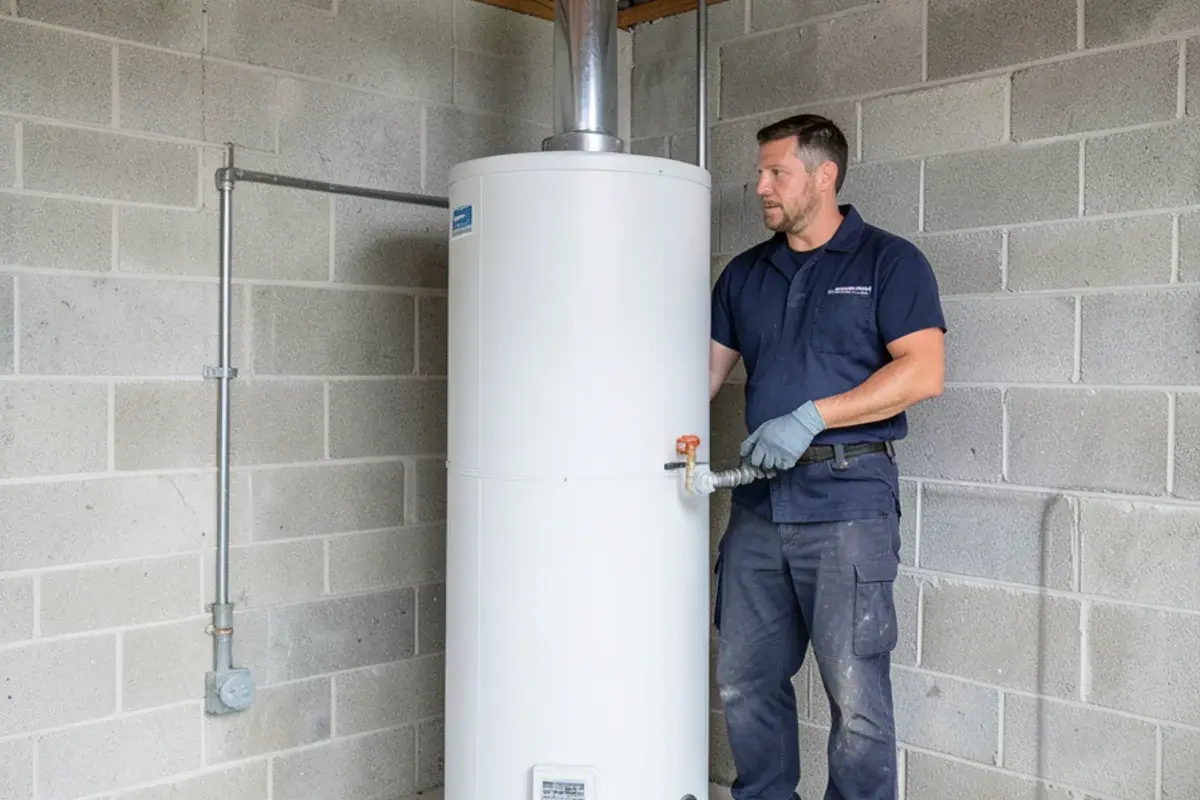
Figures come from a 2009 DOE Building America document, so check current models. The shape of the trade-offs has not changed.
Water heater giving out? Call (209) 563-1400
Open 7 days, 7:15 AM to 6:15 PM. Tell us what is happening and we will give you a clear, upfront quote.
When Does a Tank Water Heater Make Sense?
A tank wins when the house is simple and the budget is tight. It is the better buy when the existing gas line and flue already suit it, when the household is small, or when you want the lowest cost and the least fuss. Green Building Advisor notes that storage heaters are less expensive and less prone to mechanical problems. If a tank fails on a cold morning, replacement is also usually the simpler job.
A third-party estimate puts water heater installation in Washington at about $772 to $1,931 (Today's Homeowner, an estimate, not our quote). The tank itself, its size and the venting work move the number.
When Does a Tankless Water Heater Make Sense?
Tankless wins when space is tight, hot water use is steady, and you plan to stay. There is no 40 or 50 gallon tank to heat all day, and the DOE-linked document estimates bills can fall 10 to 20%. A tankless unit does not run out partway through a long shower, as long as the flow stays within its rating.
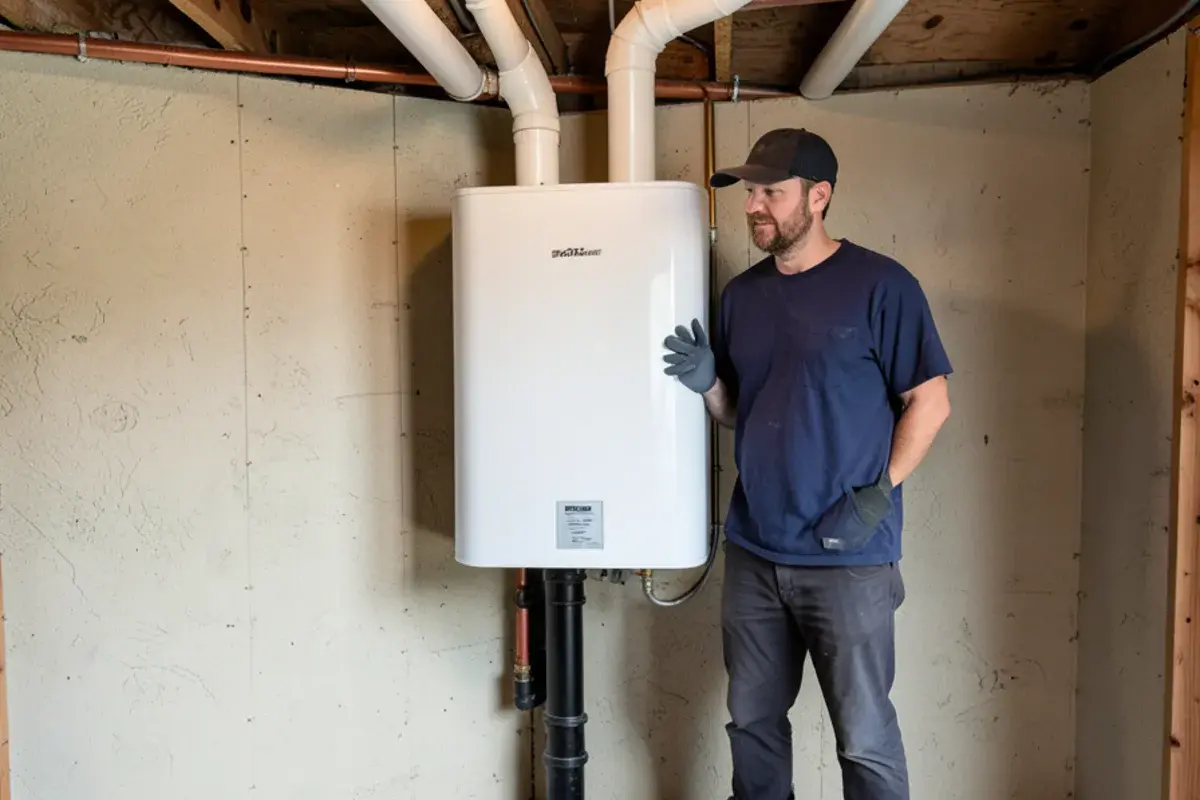
The catches matter. The same sources note these:
- Gas supply. Burners run 150,000 to 200,000 Btu per hour against about 40,000 for a typical tank, so the unit typically needs a larger gas line and a bigger flue.
- Venting. It can be expensive, so the location matters.
- Minimum flow. Many units need about 0.5 gallons per minute to fire, which a low-flow faucet may not reach.
- Power. A gas tankless unit usually has an electric connection, so it stops in an outage.
- Scale. High mineral content scales the heat exchanger, and the owner's manual calls for flushing. Our post on what hard water does to your plumbing explains why this matters here.
Condensing or Noncondensing?
This choice changes the install as much as the bill. The Building America Solution Center puts noncondensing units at about 80% efficient and condensing units above 90%, and says ENERGY STAR generally goes to condensing models. A condensing unit can vent in PVC because its exhaust runs cooler, but it makes acidic condensate that needs a neutralizer and a drain. A noncondensing unit needs corrosion-resistant vent, such as Category 3 stainless. Many makers also recommend yearly professional descaling in hard-water areas, so ask for flush valves at installation.
The Shared Flue Nobody Mentions
In many basements the old tank shares a flue with the furnace. Take the tank away and the furnace can be left with a flue that no longer draws properly, which the same guide calls an orphaned flue. The fix may be small or it may not, so it belongs in the quote, because that exhaust is carbon monoxide.
How Do Illinois Winters Change the Choice?
Cold groundwater means a bigger temperature rise. A tankless unit that heats 5 gallons per minute by 60°F in mild conditions has less flow to give when the inlet water is colder. Washington's cold season runs about December 1 to March 1 with highs under 43°F, so size the unit for the coldest week, not the average one.
Here is what that does to one unit. For a given output, flow times temperature rise stays about the same. Take the Department of Energy document's 5 gallons per minute at a 60°F rise, and a 120°F target. The inlet temperatures below are for the arithmetic only and are not a measurement of any local supply, and the shower count uses the 1.5 gallons per minute of hot water that the Building America guide assumes.
| Water entering at | Rise needed | Flow left | Showers at once |
|---|---|---|---|
| 60°F | 60°F | 5 gallons a minute | About 3.3 |
| 50°F | 70°F | About 4.3 gallons a minute | About 2.9 |
| 40°F | 80°F | About 3.75 gallons a minute | About 2.5 |
A dishwasher or washer running at the same time eats into that last row. Ask your plumber to size from the maker's flow chart at your January inlet temperature, not from the headline rating.
A tank has the opposite problem. It holds a reserve, but recovery after a long shower takes longer on cold days. Sizing either type is a plumber's job: fixtures, family size and the line from the street all count.
Five Questions to Answer Before You Choose
Run these before you compare prices, because each one can settle the matter on its own.
- How many showers and appliances really run at once on your busiest morning?
- Can the gas line reach the unit at full flow, with every other gas appliance running? Tankless units often need a 3/4-inch branch where a tank gets by on 1/2-inch.
- Is there a wall the vent can reach, and does the old heater share a flue?
- What does your water test say about hardness, and who will descale the unit each year?
- How long will you stay, and do you need hot water during an outage?
If question 2 or 3 turns into a big project, the tank usually wins on cost alone. Our breakdown of water heater replacement cost puts published numbers on both installs.
The Honest Verdict
Choose a tank if you want the lowest cost, your gas line and flue already suit it, or the household is small and uses hot water in short bursts. It is the safer pick when the budget is tight or you may sell within a few years.
Choose tankless if you have steady, heavy hot water use, you plan to stay 15 years or more, and the home can take the gas and vent work. It is the better pick when space matters and standby heat loss bothers you.
Choose neither without sizing. A tankless unit that is too small for January, or a tank that is too small for a busy morning, is the worst result of all.
Is a Heat Pump Water Heater the Third Option?
It can be, in a basement with room for it. ENERGY STAR says heat pump units run best where the surrounding air stays at or above 40°F, that hybrid models keep working below that, and that most can go where the old heater sat. It is a tank with its own electrical and space needs, not a gas swap, so the two questions are whether your basement suits it and whether the electric work adds up.
What We Look For When Sizing a Heater
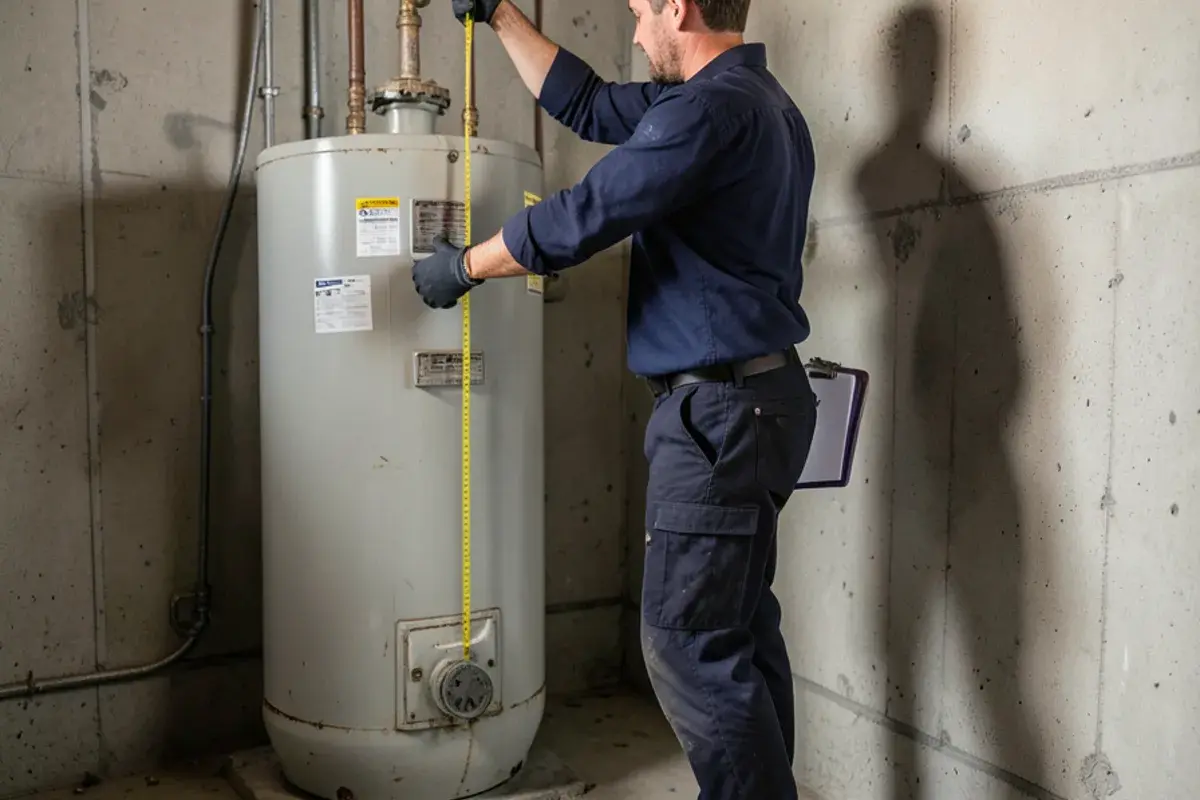
We measure the space, the gas line, the flue and the water supply before quoting. We ask how many people shower in the morning and whether the laundry runs at the same time. Then we say which type fits, even if it is the cheaper tank. Our tankless water heater page covers the process, and homeowners in Pekin and nearby towns get the same walk-through. For a straight swap, our water heater installation page explains the job.
The hard part of the trade-off is timing. A tank that has already failed pushes people toward whatever can go in fastest, and that is usually another tank. If yours still works and is getting old, this is the time to measure, because a tankless job needs more planning. And if your heater has only lost a part, water heater repair may buy you the time to decide properly.
If you are weighing a third option, Ameren Illinois has listed a $50 rebate on a new ENERGY STAR gas tank or tankless unit and a $1,150 instant discount on an ENERGY STAR heat pump water heater through participating contractors. Confirm before you buy, because programs change.
Ready to Measure?
Call (209) 563-1400 and tell us the age and fuel of your current heater, how many people live in the house and which month gives you trouble. We will look at the gas line, the flue and the space, then give you a clear, upfront quote for the option that fits, even if that is the cheaper one.
Sources
- Consortium for Advanced Residential Buildings (DOE Building America): Tankless Water Heaters
- Green Building Advisor: Storage vs. Tankless Water Heaters
- Pacific Northwest National Laboratory, Building America Solution Center: Gas-Fired Tankless Water Heaters
- ENERGY STAR: Do Heat Pump Water Heaters Work in Cold Climates?

Written by the Professional Sewer & Drain Services team
A plumbing and sewer company based in Washington, IL. About us